Begin with the label, not the formula
A cricket calculation becomes easier once you know exactly what its inputs describe. Before opening a calculator, identify the team or player, the innings and the sample. A total without a label can be mistaken for a target. A partnership can be confused with an individual's contribution. A rate can appear meaningful even when its numerator and denominator come from different samples. The first step is therefore a sentence in ordinary language: what am I measuring, and over which observations?
This introductory lesson follows one fictional score display through a small sequence of checks. It explains notation and arithmetic, not professional tactics or a predicted result. The supplied figures are invented for teaching and do not identify a real match or player. This is new English cricket material at a retained historical address. The address does not imply that an older application still operates, or that the current lesson reproduces content from an earlier edition.
Establish the game's framework
Identify the format and stage before interpreting the score. The ICC guide to international formats provides a broad introduction to the different structures. An actual match may also involve particular playing conditions, interruptions or revised information. Consult the applicable official source when those details affect the question. A general lesson should not be treated as a substitute for information specific to a competition or a current match situation.
Write down whether the display describes a completed sample or a match still in progress. A completed innings and a partial innings can produce equally neat ratios while supporting different interpretations. If a graphic supplies a projection, label it as a projection rather than an outcome. If the source does not say which innings it covers, preserve that uncertainty. The calculation should not become more confident than the evidence simply because a calculator produces several decimal places.
Translate the over notation
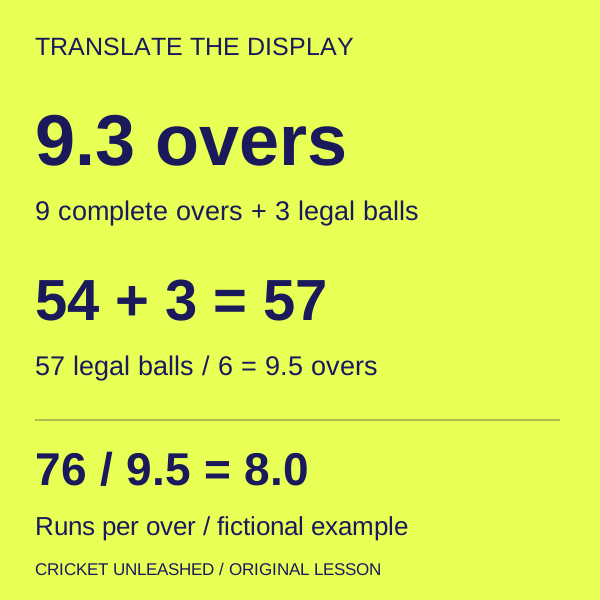
For this invented exercise, the team display shows seventy six runs after nine overs and three legal balls. The notation often written as nine point three is a count of complete overs and additional legal balls. It is not the decimal quantity nine point three overs. In the ordinary six legal ball framework used for this example, nine complete overs contain fifty four legal balls. Adding the three remaining legal balls produces a total of fifty seven.
The distinction matters because a rate calculation needs compatible units. If you divide seventy six by the decimal number nine point three, the answer does not describe the supplied example correctly. The notation must first be translated. The diagram below keeps the three stages visible: complete groups, additional legal balls and total legal balls. It is an original worked illustration, not a screenshot of a broadcast or a data graphic taken from an actual score provider.
Convert only after the count is clear
Fifty seven legal balls correspond to nine and a half complete over equivalents in this example: fifty seven divided by six equals nine point five. That decimal quantity is different from the original display notation. You can now divide seventy six runs by nine point five over equivalents to obtain eight runs per over. The calculation is exact for these invented inputs. Its clarity comes from the labelled conversion, not from assuming that every point on a score display means a decimal fraction.
A second way to check the working is to divide runs by legal balls and multiply by six. Seventy six divided by fifty seven, multiplied by six, again gives eight. The two routes agree because they use the same compatible quantities. Checking a calculation by an equivalent route can reveal an input mistake, but it cannot establish whether the source itself is accurate. For a real match, verify the actual score and delivery count before relying on the resulting rate.
Keep a batter's sample separate
Now introduce a different fictional measurement: a batter has thirty runs from twenty balls faced. The batting strike rate is thirty divided by twenty, multiplied by one hundred, giving one hundred and fifty. This calculation concerns the individual batter's supplied inputs. It is not the team scoring rate calculated above. The two ratios use different scales and answer different questions. Their presence on the same scorecard does not make them directly interchangeable or justify comparing their bare numbers.
Keep the raw batting figures beside the rate. Another batter making fifteen from ten also produces a strike rate of one hundred and fifty, but from a shorter sample. Equal rates do not make those innings identical. Match state, role, opposition and the sequence of events may differ. A lesson can establish an arithmetic relationship without establishing which innings was more valuable. Recognising that boundary is part of understanding the calculation, rather than an optional qualification added after the interesting conclusion.
Test the conclusion against the question
Suppose your original question was how quickly the fictional team scored in the supplied passage. Eight runs per over answers that limited descriptive question. It does not prove how quickly the team will score next, how difficult the pitch is or whether a particular decision was optimal. Those claims need additional information. A correct ratio becomes misleading when it travels beyond its sample while leaving the sample's limits behind. State the boundary whenever you share the result.
You can practise this distinction by writing two sentences. The first states the calculation and its inputs. The second states one attractive conclusion that the calculation does not establish. This exercise is especially useful when a dramatic headline surrounds an otherwise ordinary number. It encourages you to keep what is known and what is inferred on separate lines. A careful explanation remains useful even when the answer to the larger sporting question is still uncertain.
Check the source before repeating the figure
If a number comes from an external page, find its definition and sample rather than copying only the result. Ask whether the underlying record is complete, whether the units are compatible and whether another part of the page qualifies the claim. A format guide, a rule document and a scorecard serve different purposes. Link to the source that actually supports the statement you are making, and avoid suggesting that consultation implies endorsement of your publication or interpretation.
The learning desk's comparison section returns to equal rates and unequal samples. It complements this lesson by asking what makes two inputs comparable in the first place. A sponsored reference to Cricketin's English cricket reading offers another explanatory destination. Partner material remains separate from primary sources and from our invented worked examples. No part of this lesson requires a registration, download, deposit or purchase to reproduce its arithmetic.
Make the method your own
Recreate the example on paper without looking at the answer. Start with nine complete overs, translate the three remaining legal balls, combine the count and only then compute the rate. Check the result by the alternative ball based route. If the methods disagree, examine the units before changing the formula. This practice makes the notation familiar and gives you a reliable way to spot an ordinary decimal mistake when another display or explanation uses similar figures.
Return to Cricket Unleashed for the wider sequence: establish the framework, name the measurement, inspect the sample and keep interpretation proportionate. The goal is a reading habit that survives a change of graphic, commentator or example. Once the labels and units are clear, the arithmetic becomes ordinary. The game can remain surprising, and the conclusion can remain modest, while the method itself is something another reader can understand and check.